

Earlier this month, the man who coined the term “vibe coding” declared it dead.
Twelve months. That’s how long it took for “talk to AI and it writes your code” to go from breakthrough to baseline. OpenAI cofounder Andrej Karpathy’s replacement term? Agentic Engineering. Not coding. Not prompting. Orchestrating autonomous agents that plan, build, test and ship software on your behalf.
“AI isn’t coming to take your job. Someone using AI is coming to take your job. The first thing everyone should do is learn to use AI so they can augment their own productivity.”
Jensen Huang – CEO of NVIDIA
The implications for every enterprise are immediate.
Five months ago at JuiceIT Melbourne, I flashed an “Expression of Interest” QR code on the screen. Just an idea. I wanted to see if it resonated.
It did.
Last week my colleague Genevieve Wood and I ran a new Agentic AI workshop in the Melbourne office for a dozen aspiring builders. Enterprise professionals. Hands on. Real tools. Building, not watching.
One participant opened with an apologetic shrug. He hadn’t done much with AI, he said. “Just” ChatGPT, Gemini, Perplexity, Grok and Claude Code. The truth is, he was exposed to more AI surface area than 99 per cent of the planet. He thought he was behind.
In spite of showing up and putting in the work to learn new skills, they all felt late to the party. That’s why I’m writing this.
What happened in that room tells you everything about where we are right now. Consider this: according to Microsoft’s AI Diffusion Report, 84 per cent of the world’s population has never had a single conversation with AI. Of the remaining 16 per cent who have tried a free chatbot, just 0.3 per cent pay for a subscription, and the share who have actually built something with tools like Cursor or Claude Code? Around 0.04 per cent. If you are reading this blog and you have used AI at work, you are already in a vanishingly small minority. If you have built an agent, you are a rounding error. We are not at the end of AI adoption. We’re not even at the beginning of the middle. We are at the very start.
Rewind to 2024. Python overtook JavaScript as the world’s most-used programming language. Not because of web development, but because of AI builders. By 2025, TypeScript overtook both. GenAI projects on GitHub doubled in a single year. From Python to TypeScript to vibe coding to agentic engineering. In 2026, the most important programming language might just be English.
Google’s CEO reported that over 30 per cent of the company’s new code is now AI-generated. By 2028, IDC predicts 70 per cent of net-new digital solutions will be created using natural language.
Claude Code. Cursor. Codex. Antigravity. The tools shipped months ago. Your people are already using them. The question is whether your organisation knows about it.
At home, building with AI without guardrails means a side project breaks. You learn, you iterate, no harm done.
In enterprise, the stakes compound fast.
Gartner expects that by late 2026, around 40 per cent of enterprise applications will feature task-specific AI agents. In 2025, that number was under 5 per cent. Shadow AI is the new shadow IT, except this version can write code, touch customer data and make decisions at speed
Weeks ago, Cisco’s security researchers found a third-party plugin in a popular open-source AI agent silently exfiltrating data. No alerts. No user awareness. Just data walking out the door.
Your builders need to build, but they need to build right. This is not a call to slow down. It’s a call to build with governance, oversight, and with guardrails while the building is already happening.
Not every organisation faces this urgency equally. If your enterprise runs on knowledge work, you’re in the crucible right now. Professional services. Financial services. Government. Media. Technology. Your work is made of exactly the material that agentic AI was built to transform.
The WINS framework maps which industries face the most immediate displacement pressure, based on how much of their cost base sits in words, images, numbers, and sounds.
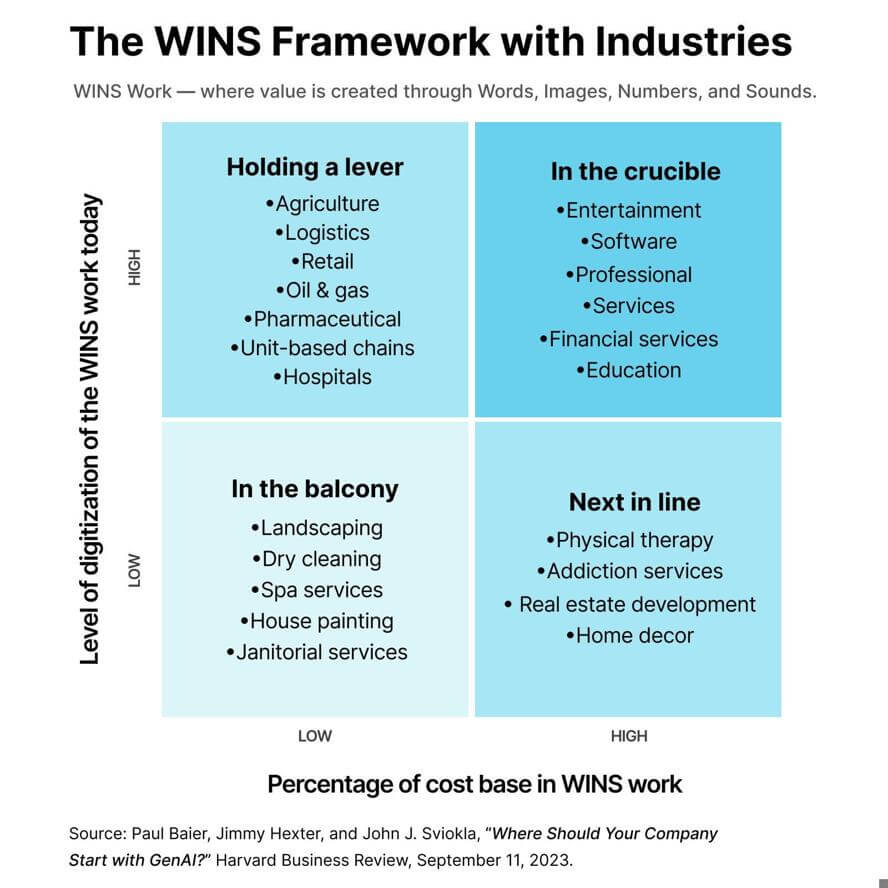
The future, as William Gibson put it, is already here. It’s just not very evenly distributed. For those of you already leaning in, already building, already asking the hard questions; 2026 is your year.
Join us at JuiceIT 2026, where we’ll be exploring The Tech Effect: how synchronising today’s technologies, people and strategy turns innovation into real business momentum.
Business Aspect Principal Consultant, Dr Daniel Thomas, and I will be running a fast-paced, story‑led tour of Vibe Coding at the edge. You’ll also hear our real‑life experiences where agents delivered value at lightning speed, along with insights into the challenges we encountered along the way.
The year of the Agentic AI Builder is here. The only question is whether your team is building with you, or without you.
Information provided within this form will be handled in accordance with our privacy statement.